
Before today’s travel journals, early iPhone apps experimented with turning social posts into a record of a trip. Our September 2010 article, “Join the Journey,” featured two such apps: Blacktop and TrackinU Universal. This historical guide identifies both and explains what the original links referred to.
Blacktop: a journey built from check-ins
Our archived coverage described Blacktop as a way to group Foursquare and Facebook check-ins into trips. People could add photos and comments to places along the route, then share the journey on Facebook. The listing identified Zenbe, Inc. as the seller and Apple app ID 386017063.
The appeal was a simple one: a collection of individual check-ins could become a story about a night out or a vacation. That distinction matters when revisiting the app—it documented visits and memories rather than supplying turn-by-turn directions.
TrackinU Universal: mapping geotagged tweets
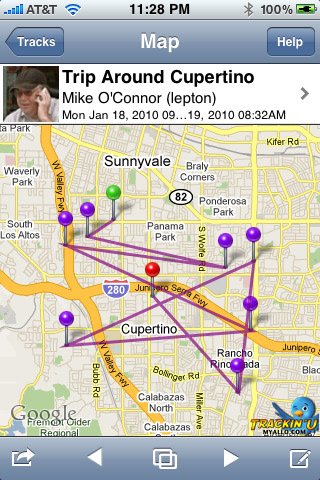
TrackinU Universal used a different source: tweets with location information. The original article described recording geotagged tweets, making a track for a particular trip, and saving or sharing the resulting map. Its historical Apple app ID was 353499744.
The original product screenshot shown here illustrates the idea with a “Trip Around Cupertino” map. Markers are connected across the area, showing how a sequence of location-tagged posts could become a visible route. This is an archived screenshot, not evidence of a service operating today.
Are these apps still available?
A check of Apple’s US catalog on October 15, 2026 returned no results for either historical app ID. We cannot verify a current US download, working social-network connections or compatibility with current iPhones. Names alone are not enough to identify an old app; retain the app ID when checking a past purchase or bookmark.
For apps currently appearing in the store’s charts, visit our iPhone App Store rankings.
Source and image: iPhoneApplicationList’s archived “Join the Journey” article and its original TrackinU Universal screenshot, preserved by the Internet Archive. Features above describe the historical releases.