
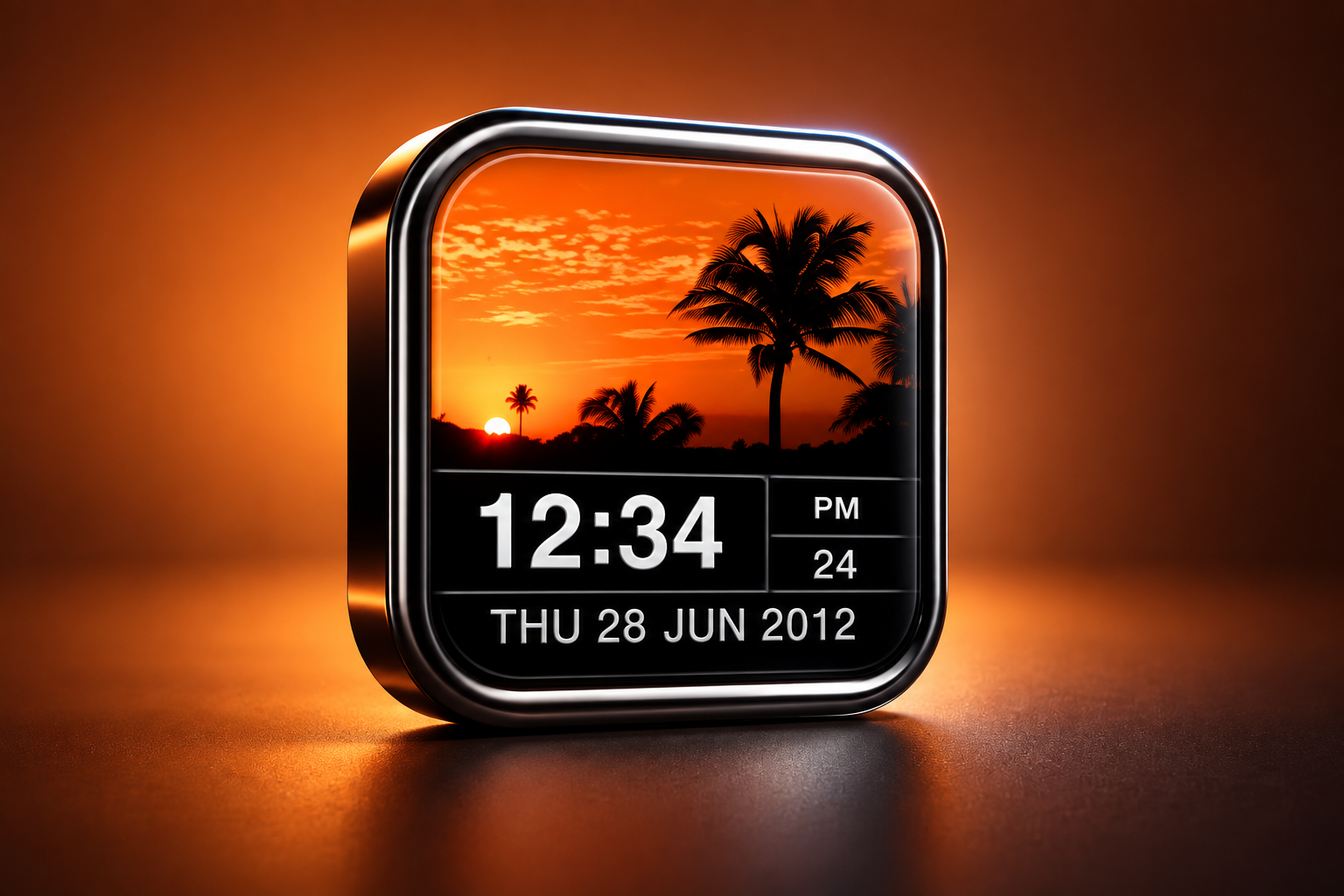
PhotoFrame took an everyday moment—leaving an iPhone in its dock—and gave it a second purpose. Chilli X’s app displayed photographs with a clock and date, turning a charging device into something personal on a desk. Its developer’s surviving app catalogue documents that idea alongside the company’s other clock and display experiments.
A small display rewards a small collection
The appeal of a photo frame is different from browsing a photo library. A library helps you find a particular memory; a frame lets a few chosen memories remain part of the room. That distinction makes selection more important than quantity. A handful of images with clear subjects usually works better than a complete holiday album containing receipts, screenshots and near-duplicates.
For a display viewed from across a desk, choose pictures with strong shapes and uncluttered backgrounds. Keep faces away from the outer edges, where cropping can remove the most important part of the photograph. Landscape and portrait images may need separate crops instead of one compromise that suits neither orientation.
Recreating the idea today
This is a historical profile, rather than a claim that the original PhotoFrame remains compatible with present devices. To reproduce its purpose, begin by making a dedicated display album in your preferred photo software. Review every image at the actual size at which it will appear. A photograph that looks wonderful enlarged may become unreadable on a compact screen.
Then decide whether the display belongs on a working desk, beside family pictures or on a bedside table. That choice determines brightness, image rotation and whether a visible clock is useful. PhotoFrame’s lasting lesson is simple: the best secondary use for a screen may be a carefully selected picture, presented without demanding another tap.